
Overview
Building Strong Mathematical Thinkers or Thinking Beyond the Answer.
Grades 3–5 are a turning point in a student’s mathematical development. During these years, children move beyond mastering basic skills and begin to think more deeply about mathematical ideas and problem-solving strategies.
At Studio of Engaging Math, our goal is to develop students who don’t just know how to solve problems—they understand why their solutions work. Instead of relying on memorization and repetitive practice, students learn to analyze problems, recognize patterns, compare different strategies, and explain their reasoning. They become confident, independent thinkers who are ready to tackle unfamiliar challenges.
Our curriculum extends well beyond the traditional school program. Along with arithmetic, students explore logic, geometry, algebraic thinking, and challenging non-routine problems that deepen their understanding of mathematics.
Whether our students pursue careers in science, engineering, business, medicine, the arts, or entirely different fields, they leave this program with something valuable for every path: the ability to think logically, solve problems creatively, and approach new challenges with confidence.
Curriculum Grade 3
Arithmetic
- Addition and Subtraction of 3-digit numbers
- Standard algorithm
- Mental math strategies: adding and subtracting compatible numbers, rounding, adding and subtracting parts
- Multiplication and Division
- Understanding the concept of multiplication as repeated addition
- Multiplying a 2-digit number by a 1- digit-number using distributive law for multiplication
- Mental math strategies: finding compatible numbers, rounding
- Understanding the concept of division as an inverse of multiplication
- Division with remainder
- Order of operations: introduction
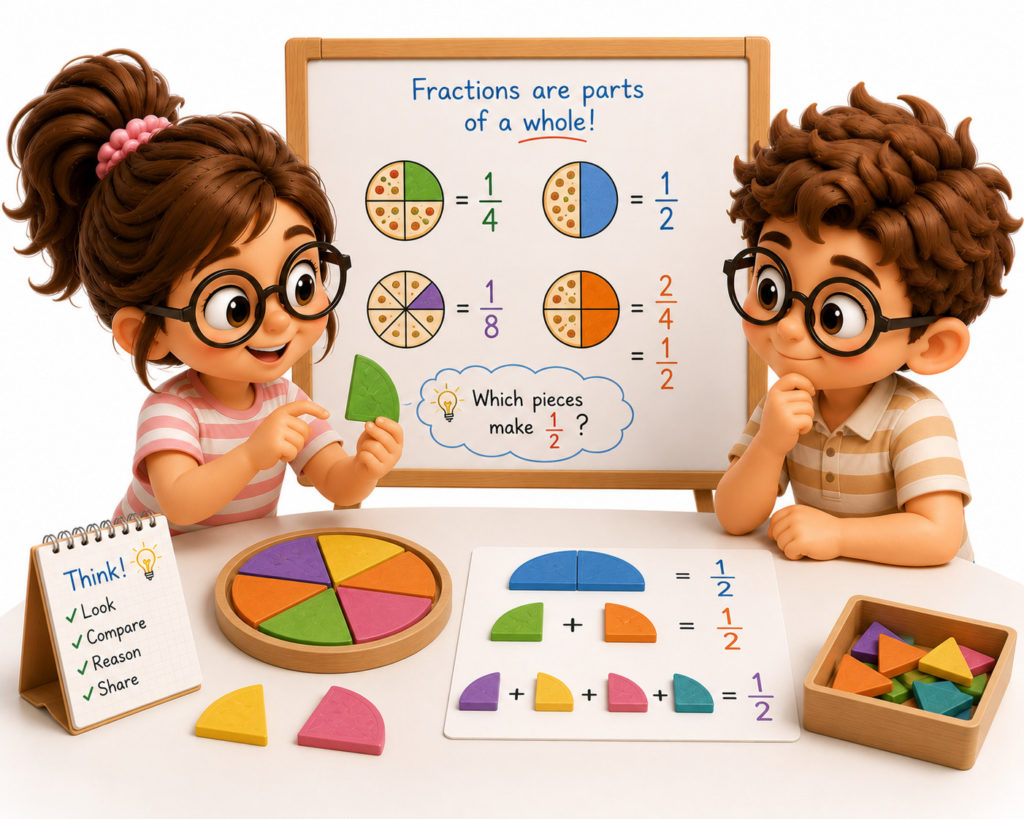
- Fractions: introduction to basic concepts
- Improper fractions and mixed numbers
- Equivalent fractions
- Comparing fractions
- Number Sense
- Understanding of 4-digit numbers. Value and place value
- Guess the number puzzles
- Missing numbers puzzles
Geometry
- Identifying basic plane figures
- Angles
- Polygons
- Introduction to area and perimeter of rectangles
- Introduction to volume
- Identifying basic types of solids
- Vertices, edges and faces of polyhedrons
- Shapes with curved surfaces
- Composite solids
- Transformations and symmetry
- Development of spatial and geometric thinking
- Dissections of squares and circles
- Coloring regions on a map problems
- Copying and transforming designs on a grid
- Paper folding and cutting problems
- Unicursal tracing
- Engineering drawing and projections
Logic
- Methods and techniques for solving logic problems
- Logic grids
- Introduction to sets and Venn diagrams
- Relations and ordering
- Nonverbal reasoning: analogies, patterns, grouping and classification of objects
- More difficult logic problems: pigeonhole principle, fencepost error, jug problems, crossing the river problems
Word problems
One step and multi-step word problems involving addition, subtraction, multiplication and division of whole numbers
Algebraic thinking
- Algebra shape puzzles
- Balance puzzles
- Elements of algebra: proportional reasoning, graphs, number patterns
Investigation and math olympiad problems
- Various types of investigation problems
- Math Kangaroo, Math Counts and CML problems
Curriculum Grade 4
Arithmetic
- Addition and Subtraction of 4 and 5-digit numbers
- Standard algorithm
- Mental math strategies:
adding and subtracting compatible numbers, rounding, adding and subtracting parts - Estimation for addition and subtraction
- Multiplication and Division
- Multiplying 3-digit numbers by 1- digit-numbers using distributive law for multiplication
- Dividing 3-digit numbers by 1 and 2-digit divisors using distributive law for division
- Mental math strategies: finding compatible numbers, rounding, multiplication and division by 5
- Multiplication and division of round numbers
- Estimation for multiplication and division
- Order of operations
- Fractions
- Basic concepts: improper fractions and mixed numbers, equivalent fractions and comparing fractions
- Adding fractions with different denominators
- Subtracting fractions with different denominators and subtraction with regrouping
- Introduction to decimals
- Number Sense
- Understanding of 5-digit numbers. Value and place value
- Factors and multiples
- Divisibility of natural numbers
- Missing numbers puzzles
Geometry
- Basic geometric shapes
- Points, lines, and angles
- Measuring angles using protractor
- Triangles
- Quadrilaterals
- Solids
- Area and perimeter of rectangles
- Volume
- Development of spatial and geometric thinking
- Engineering drawing and projections
- Nets of solids
- Dissections
- Paper folding and cutting problems
- Unicursal tracing
Logic
- Methods and techniques for solving logic problems
- Logic grids
- Venn diagrams
- Modeling problems on a number line
- Relations and ordering
- Nonverbal reasoning: analogies, patterns, grouping and classification of objects
- More difficult logic problems: pigeonhole principle, fencepost error, jug problems, crossing the river problems
Word problems
- Multi-step word problems with whole numbers
- One step and multi-step word problems with fractions
- Finding part given a whole
- Finding whole given its part
- Problems involving addition, subtraction, and comparing of fractions
Pre-algebra
- Algebraic expressions
- Translating algebraic expressions
- Simplifying expressions with variables by combining like terms
- Balance puzzles (introduction to equations)
- problems of Number Codes (introduction to systems of equations)
- Development of algebraic thinking: proportional reasoning, graphs, number patterns
Investigation problems and Math Olympiad
- Various types of investigation problems
- Math Kangaroo, Math counts and CML
Curriculum Grade 5
Arithmetic
- Review of addition and subtraction of 4 and 5-digit numbers using standard algorithm and various mental math strategies
- Review of multiplication and division of 3 and 4-digit numbers using standard algorithms and various mental math strategies
- Distributive law for multiplication and division
- Introduction to negative numbers
- Basic idea of a negative number: negative numbers on a number line, finding opposites, compare
- Expanding the ideas of addition, subtraction, multiplication and division to include negative numbers
- Negative fractions and decimals
- Order of operations with positive and negative numbers
- Fractions
- Multiple strategies for comparing fractions
- Review of addition and subtraction of fractions and subtraction with regrouping
- Multiplication and division of fractions
- Basic ideas of decimals: place values, rounding
- Addition and subtraction of decimals
- Multiplication and division of decimals
- Introduction to percentage
- Number Sense
- Understanding of 6-digit numbers. Value and place value
- Factors and multiples. Finding GCF and LCM
- Composite and prime numbers
- Divisibility rules
- Advanced missing numbers puzzles
Geometry
- Basic geometric shapes
- Parallel and perpendicular lines
- Triangles and their angles
- Construction of triangles
- Quadrilaterals and their angles
- Solids
- Measurement
- Area and perimeter of rectangles and composite shapes
- Volume of cuboids and word problems involving volume
- Development of spatial and geometric thinking
- Engineering projections
- Nets of solids
- Plane dissections: straight line and curved
- Paper folding and hole punching problems
- Advanced unicursal tracing problems
Logic
- Methods and techniques for solving logic problems
- Logic grids
- Venn diagrams
- Modeling problems on a number line
- Nonverbal reasoning: analogies, patterns, grouping and classification of objects
- More difficult logic problems: pigeonhole principle, fencepost error, jug problems, crossing the river problems
Word problems
- Multi-step word problems with whole numbers
- One step and multi-step word problems with fractions
- Ratio
- Percentage
- Average
- Motion
Pre-algebra
- Algebraic expressions
- Translating algebraic expressions
- Simplifying expressions with variables by combining like terms and opening parentheses
- Problems of Balance (introduction to equations)
- Introduction to basic methods of solving linear equations
- Problems of Number Codes (introduction to systems of equations)
- Introduction to powers and exponents
- Development of algebraic thinking: proportional reasoning, graphs, number patterns
Investigation problems and Math Olympiad
- Various types of investigation problems
- Math Kangaroo, Math counts and CML problems
About this course

Word Problems
How Can You Turn a Story into a Solution?
Word problems are where mathematics comes to life. Students learn to analyze real-world situations, identify the important information, translate it into mathematical expressions and equations, and develop a plan before beginning any calculations.
Rather than relying on keywords or memorized procedures, students use diagrams, bar models, tables, and other visual strategies to organize information and reveal the relationships within a problem. These tools help them confidently solve unfamiliar and multi-step problems.
As students progress, they tackle increasingly sophisticated problems involving fractions, ratios, percentages, rates, and other applications. Along the way, they discover that understanding the problem is always the first step toward finding the solution.

Critical Thinking
Can You Explain Why?
Mathematics is more than finding the correct answer—it’s about understanding why it works. Throughout the course, students learn to analyze problems, recognize patterns, evaluate different strategies, and justify their reasoning.
Many of the problems we present have more than one possible solution or more than one effective approach. Students compare ideas, discuss their thinking with classmates, and discover that explaining their reasoning is just as important as finding the answer.
These habits help students become confident, independent thinkers who are prepared to solve unfamiliar problems both in mathematics and beyond.

Logic Problems
Can You Find Another Way?
Logic problems are some of our students’ favorite challenges because they rarely have an obvious solution. They encourage creativity, persistence, and the confidence to explore different approaches instead of relying on familiar methods.
Throughout the curriculum, students solve a wide variety of non-routine puzzles that require careful reasoning, pattern recognition, and strategic thinking. They learn that there is often more than one path to the correct answer—and that an unexpected solution can be just as elegant as a familiar one.
Many of these problems are explored through class discussion, where students compare strategies, build on one another’s ideas, and discover that collaboration often leads to deeper understanding.

Pre-Algebra
Can You See the Rule?
Algebra is much more than solving for x. It’s about recognizing patterns, discovering relationships, and expressing mathematical ideas using symbols. Throughout Grades 3–5, students gradually develop algebraic thinking long before they take a formal algebra course.
Students learn to write and solve equations, work with variables, reason about unknown quantities, and generalize mathematical relationships. Rather than memorizing rules, they develop an understanding of why algebraic methods work and how they connect to the mathematics they already know.
By the time students begin formal Algebra, they are already comfortable thinking abstractly, solving equations, and recognizing mathematical structure—giving them the confidence to succeed in middle school mathematics and beyond.

Geometry & Spatial Reasoning
Can You Think in Three Dimensions?
Geometry is much more than learning the names of shapes. Students investigate the properties of two- and three-dimensional figures, discover geometric relationships, and develop an understanding of perimeter, area, volume, angles, symmetry, and transformations.
Through drawing, measuring, constructing, and solving geometric challenges, students learn to think both visually and logically. They use rulers, protractors, compasses, and a variety of hands-on materials to explore mathematical ideas with precision and confidence.
Spatial reasoning is an essential part of this process. Students solve puzzles, build with construction sets, mentally rotate objects, and visualize shapes from different perspectives. These experiences strengthen the visual thinking skills that support success in geometry, algebra, engineering, architecture, and many other STEM fields.
Together, geometry and spatial reasoning prepare students for our middle school formal geometry course, where they study theorems, write proofs, and solve increasingly sophisticated geometric problems.

Math Competitions
Can You Rise to the Challenge?
Math competitions are a natural extension of our curriculum. Throughout the year, students solve carefully selected problems inspired by competitions such as Math Kangaroo, Noetic Learning Math Contest, and other national and international math Olympiads.
These challenging, non-routine problems encourage students to think creatively, persevere, and discover elegant solutions. Along the way, they develop confidence, resilience, and a deeper appreciation for mathematics.
We encourage all interested students to participate in math competitions. Year after year, our students earn top awards and outstanding results, but we believe the greatest achievement is learning to enjoy a challenge and think independently.
We Believe
What to Expect:
Classes meet once a week in groups of no more than seven students. The small class size gives every student the opportunity to participate in discussions, explain their reasoning, and receive individual guidance from the teacher.
Our classes go beyond the traditional school curriculum. Students solve non-routine problems, explore multiple solution strategies, and tackle logic puzzles, mathematical games, and hands-on activities that develop deeper mathematical understanding.
We believe students make the greatest progress when teachers, students, and parents work together. As children become more independent learners, parents continue to play an important role by encouraging good study habits, celebrating effort, and taking an interest in what their child is learning. We keep parents informed about their child’s progress and are always available to answer questions or discuss ways to support learning at home.
Homework is an essential part of the learning process. Each week’s assignments reinforce classroom learning, encourage independent thinking, and prepare students for new concepts and increasingly challenging problems.
What Your Child Will Gain
Students learn to approach unfamiliar problems with confidence. They develop strategies, persevere through challenges, and discover that difficult problems can often be solved in more than one way.
Students learn to analyze information, recognize patterns, and make logical connections. They become comfortable explaining their reasoning and evaluating different approaches to a problem.
Rather than accepting rules at face value, students learn to ask questions, explore ideas, and understand why mathematical concepts work. This curiosity helps them become more thoughtful and independent learners.
A deep understanding of mathematical concepts prepares students for middle school and beyond. More importantly, it gives them the confidence to tackle new ideas and increasingly challenging mathematics.